|
|
|
Your one-stop solution for all school safety needs.
Spring NEWS 2026
|
|
|
|
|
|
|
|
Susan Peng-Cowan | Behavioral Health Navigator
|
|
|
|
|
Corina McEntire | Comprehensive School Safety-Public Health Coordinator
|
|
|
|
Don Lawry | Threat Assessment Coordinator
|
|
|
|
Travis Effinger | Threat Assessment Coordinator
|
|
|
|
|
|
|
Are you in search of training opportunities? Check out pdEnroller for Regional School Safety Center Events
|
|
In-person and online training options are available now.
|
|
|
|
|
|
|
|
Your Regional Partner in
School Safety and Wellness
|
The Regional School Safety Center (RSSC) was established in response to state legislation aimed at improving both mental health systems and physical security in schools. As one of nine centers across Washington, ESD112’s center serves as a regional hub for prevention, intervention, and coordination — helping schools prepare for emergencies, respond to threats, prevent and address suicide, and promote positive school climates.
|
|
Our RSSC team is led by a team of educators, mental health professionals, and safety experts with deep experience in school systems, counseling, and crisis response. We work closely with school districts, the Office of Superintendent of Public Instruction (OSPI), statewide safety partners, law enforcement, and community mental health providers to create safe, supportive environments for students and staff. Below please read about each of our programs.
|
|
|
|
BEHAVIORAL HEALTH NAVIGATOR
|
|
|
|
|
PROFESSIONAL LEARNING OPPORTUNITIES
|

|
SWACH training grant
|
Opportunity for educators in Skamania, Klickitat, or the rural communities of Clark County. If your district is in need of funding or educator contract hours for a training in the area of Mental Health or Social Emotional Learning, please contact our BHN for potential funding opportunities for rural areas. This can include current trainings you are considering or new ones. Susan.peng-cowan@esd112.org
|
|
|
|
OSPI sponsored suicide prevention trainings
|
|
|
|
|
Parent Mental Health trainings
|
Parent and community offerings to promote to your community, free of charge:
|
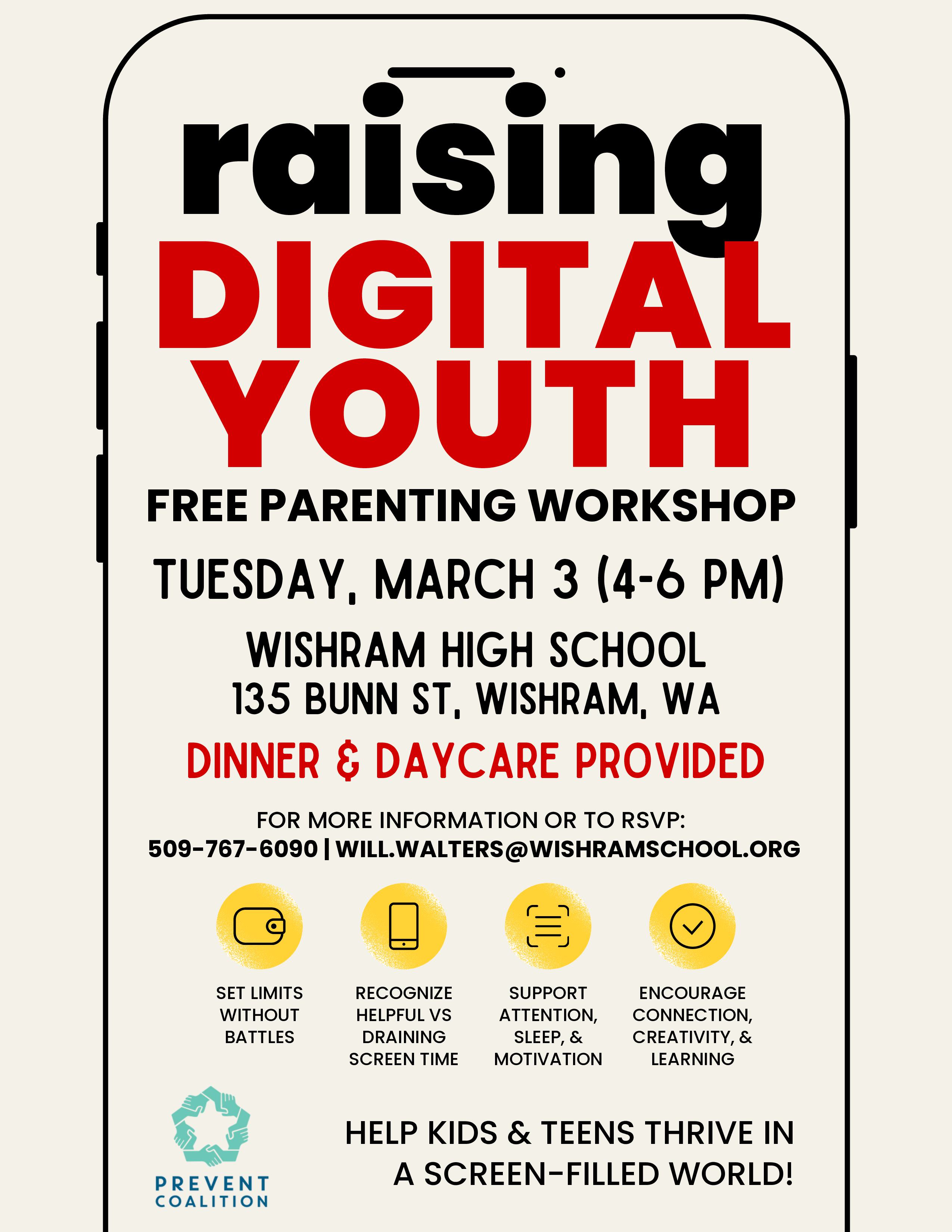
- March 3: “Raising Digital Youth: Helping Kids and Teens Thrive in a Screen-Filled World” 4-6pm hosted at Wishram School District
|
|
- March 19: Youth Mental Health First Aid 9am-3pm hosted in Stevenson
register here
|
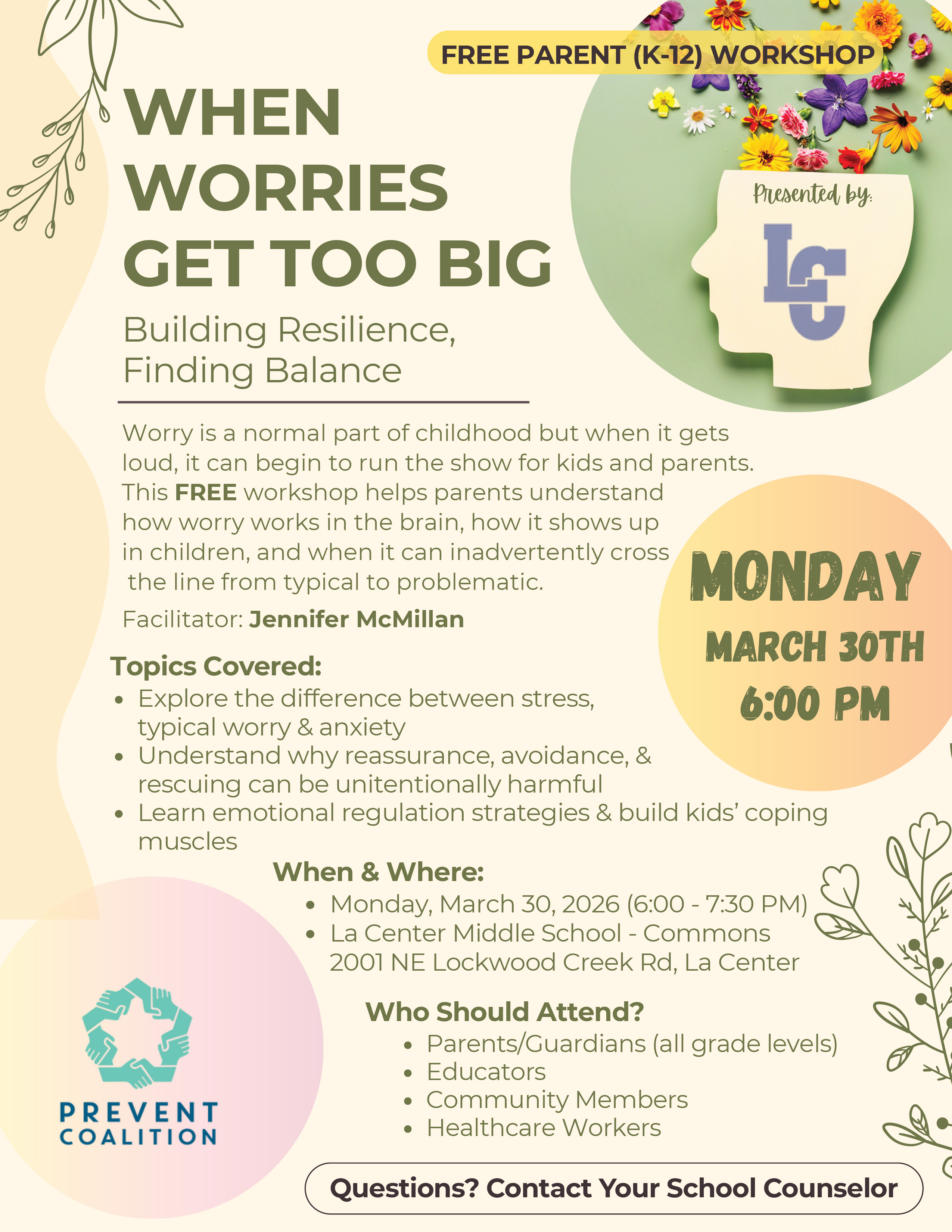
- March 30: “When Worries get Too Big” hosted at La Center School District
|
|
|
|
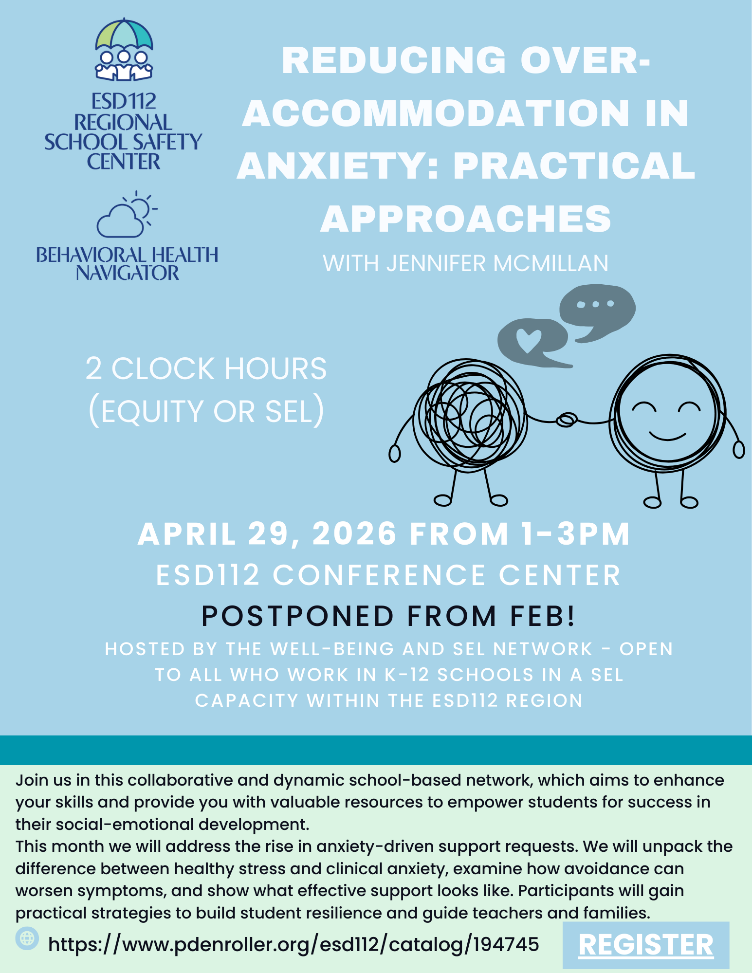
Well-Being & SEL
|
|
|
Sign up here. Clock hours are available.
|
|
|
|
|
|
QPR Training for ESAs
|
|
|
Suicide prevention trainings are offered regionally for ESAs needing PESB certification.
|
|
Here are the remaining offerings for the 2025–2026 School Year!
|
All courses held 9am–12noon
|
|
|
|
|
|
SMART
|
School Mobilization Assistance Response Teams (SMART) are available in all our districts in our region. SMART responds to schools during a traumatic event that emotionally impacts students and staff. In addition to crisis management services, SMART provides comprehensive training to help prepare your school and staff in the event of a crisis of any magnitude.
|
|
|
|
|
SMART “update” was held on February 6 on Zoom. Next SMART update for existing members will be held on 6/5/26 in person at ESD112. Registration coming soon for updates.
|
|
|
|
|
|
BHN Consultation re: RCW 28A.320.127:
|
Development of comprehensive suicide prevention and behavioral health supports for students. Your regional Behavioral Health Navigator is available to assist districts with creating district plans. RCW 28A.320.127 requires all K-12 school districts to adopt a plan to screen, recognize, and respond to indicators of Social Emotional Behavioral Mental Health (SEBMH).
|
Our BHN has collaborated with numerous districts to create these plans or formalize existing procedures into a cohesive strategy. We invite you to schedule a time to discuss developing your district’s SEMBH plan and address any questions you may have. You can use the link below to book an appointment: Behavioral Health Navigator 112 bookings
|
|
|
|
Educator training: Ready-to-Use School Curricula: Mental Health, Substance Use Prevention, and Opioid Education
|
|
We hosted a virtual training for educators in ESD112 region – if you missed it and would like more resources, please see resource sheet here
|
|
|
|
Asynchronous opportunity - Professional Learning Opportunity for educators! Trauma Sensitive Schools - High Leverage Practices in Social Emotional Learning
In September, we hosted a live, 3-part professional learning series which explored high leverage practices that build resilience. Resources and tools to support educators in working with their students were discussed and shared.
|
By the end of the series, participants were equipped with a variety of tools and interconnected strategies that support a resilient, inclusive classroom and school community.
|
|
|
|
|
|
STUDENT THREAT ASSESSMENT
|

|
Register now for upcoming in-person threat assessment trainings: 4/17/26 from 8:30-11:30 am at the ESD 112 conference center. Also, online threat assessment training dates include: 4/6/26 from 8:30-11:30 am. All administrators, principals, and school counselors are encouraged to attend, and any interested school staff are welcome too! Three CEUs are offered. You can find the trainings at RSSC - PD Enroller.
|
If you would like to schedule a threat assessment training for your district, or even just your building, please contact us. We would love to do that for you! Best practice means at least one staff member in each building is trained in threat assessment. Remember, level 1 threat assessment forms are only to be used by those who have been formally trained in the SK Cascade Threat Assessment model. If you have a situation in which you are uncertain if a threat assessment is indicated, or you just want to talk through a concern you’re having with a student, we are happy to help!
|
|
|
|
News to Know
|
|
|
Australian Social Media Ban
|
While our world is continuing to become increasingly digitized, there are pushbacks against this movement due to research showing significant harm to youth who engage with digital media. Under-16s in Australia are now banned from using major social media services. They cannot set up new accounts and existing profiles are being deactivated. The ban is the first of its kind and is being watched closely by other countries.
|
The Australian government says the ban will reduce the negative impact of social media's "design features that encourage [young people] to spend more time on screens, while also serving up content that can harm their health and wellbeing.” A study it commissioned earlier in 2025 found that 96% of children aged 10-15 used social media, and that seven out of 10 of them had been exposed to harmful content. This included misogynistic and violent material as well as content promoting eating disorders and suicide. One in seven also reported experiencing grooming-type behavior from adults or older children, and more than half said they had been the victim of cyberbullying.
|
Communications Minister Annika Wells conceded that the ban is not "perfect". "It's going to look a bit untidy on the way through," she said in early November. "Big reforms always do." Currently, Facebook, Instagram, Snapchat, Threads, TikTok, X, YouTube, Reddit and streaming platforms Kick and Twitch are banned. However, dating websites are excluded along with gaming platforms, as are AI chatbots, which have recently made headlines for allegedly encouraging children to kill themselves and for having "sensual" conversations with minors.
|
|
Australia is not alone in recognizing the dangers of the internet on youth. Denmark has announced plans to ban social media for under-15s, while Norway is considering a similar proposal. A French parliamentary enquiry has also recommended banning under-15s from social media, and a social media "curfew" for 15- to 18-year-olds. The Spanish government has drafted a law which would require legal guardians to authorize access for under-16s. In the UK, new safety rules introduced in July 2025 mean online companies face large fines or even the jailing of their executives if they fail to implement measures to protect young people from seeing illegal and harmful content. Meanwhile, an attempt in the US state of Utah to ban under-18s from social media without parental consent was blocked by a federal judge in 2024.
|
|
|
|
|
|
Behavioral Threat Assessment/Management and Autism Spectrum Disorder
|
BTAM and ASD: An e-Guide for Assessing Students on the Autism Spectrum is now available on our threat assessment website under the resource tab. Autism Spectrum Disorder (ASD) is a complex developmental condition involving persistent challenges with social communication, restricted interests, and repetitive behavior. 1 in 36 children is on the autism spectrum (Safe and Sound Schools 2025). Every autistic student is a unique individual, and not every ASD characteristic applies to each individual or impacts their behavior in the same way. There are several common ASD characteristics, each with their own risks and protective factors for BTAM teams to consider. Having knowledge of the risk and protective factors helps guide behavioral threat assessment models by including considerations for ASD characteristics in the assessment.
|
|
Always remember with BTAM and ASD, when conducting an interview and implementing a management plan with a student on the autism spectrum, make sure to set-up parameters, explain the process, set timelines, make it predictable, and let the individual know the “rules of the road.”
|
|
|
|
COMPREHENSIVE SCHOOL SAFETY
|

|
Spotlight on Preventing Youth Human Trafficking
Sex Trafficking Prevention Education (RCW 28A.320.168) requires schools in Washington to provide sex-trafficking awareness and prevention instruction between grades 7 and 12, ensuring each student receives instruction at least once before graduation. Review the OSPI Guidance Document to learn more. Visit these resources for additional research and information on prevention and support:
|
- The U.S. Department of Homeland Security’s Blue Campaign provides resources and strategies that can help the K-12 community learn the signs of youth human trafficking, report suspected trafficking, and support victims.
- Project iGuardian® – The Homeland Security Investigations team is available to inform your community of ways to protect children and teens from online predators. Presentations are delivered by HSI special agents for school communities. Reach out to Corina for your local contact.
- Know2Protect is a national public awareness campaign to educate and empower children, teens, parents, trusted adults, and policymakers to prevent and combat online child sexual exploitation and abuse (CSEA) .
- Risk Factors and Protective Actions for K-12 Schools – Schools can play an important role in preventing and responding to youth trafficking. This fact sheet lists risk factors that can make students susceptible to trafficking and related school-based protective actions that can help counteract these risk factors.
- Preventing Sexual Violence among Adolescents in Middle Schools – This one-hour webinar covers youth-centered and community-oriented strategies to prevent sexual violence among adolescents.
- YES! is an innovative evidence-informed program for Washington’s middle schools. It aims to create protective environments and reduce rates of sexual violence victimization and perpetration within school communities.
- Online Recruitment of Child Sex Trafficking Becoming Endemic – Human traffickers increasingly use online extortion campaigns to coerce vulnerable children into commercial sex work. In 2025, reports of online enticement toward children rose to nearly 520,000, roughly 80 percent higher than the year before, according to data from the CyberTipline of the U.S. government-supported nonprofit, the National Center for Missing and Exploited Children (NCMEC).
|
|
|
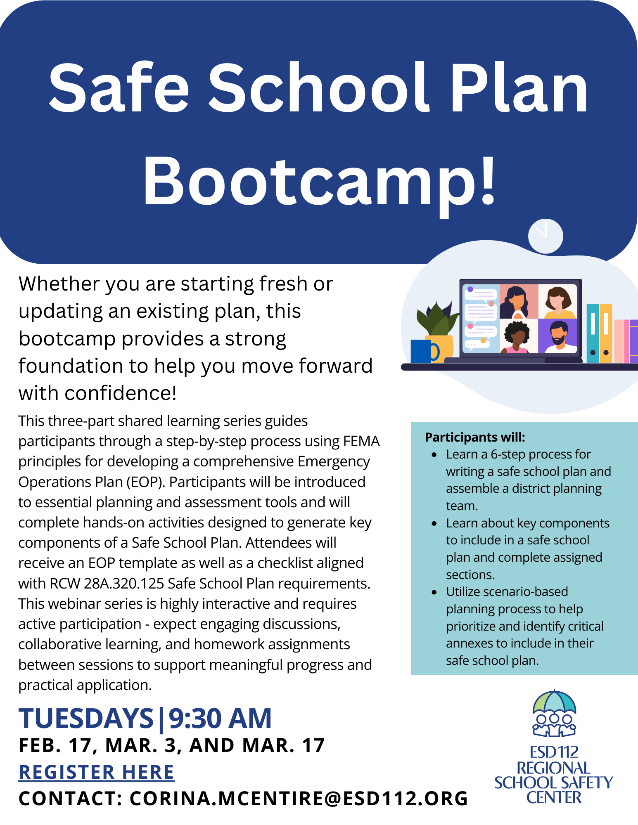
Safe School Plan Bootcamp
|
|
This three-part series is designed to help schools meet RCW 28A.320.125 Safe School Plan requirements in a focused, short-duration cohort model.
|
|
|
|
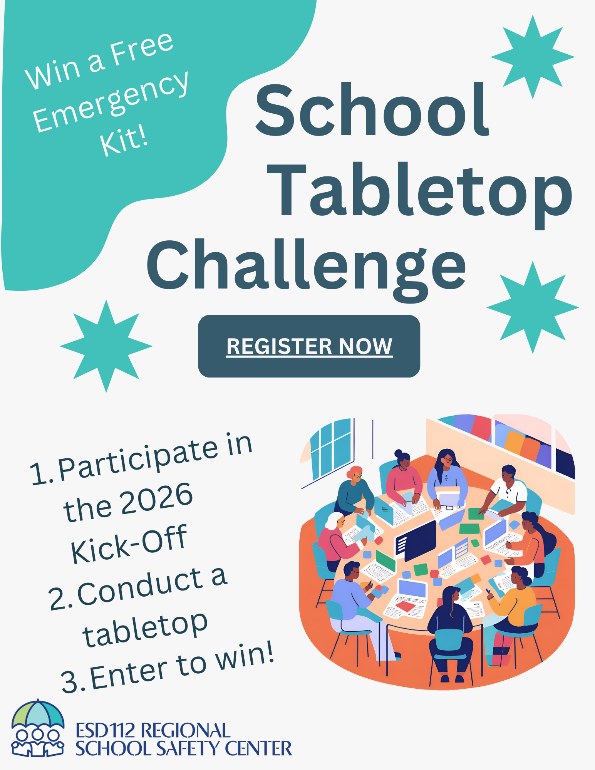
The Tabletop Challenge is Back!!
|
|
|
Register for the Kick-Off – and – enter to win! Schools can win a free emergency kit by participating in the kick-off or conducting their own tabletop exercise. All schools are encouraged to participate!
|
|
|
|
|
|
|
|
|