
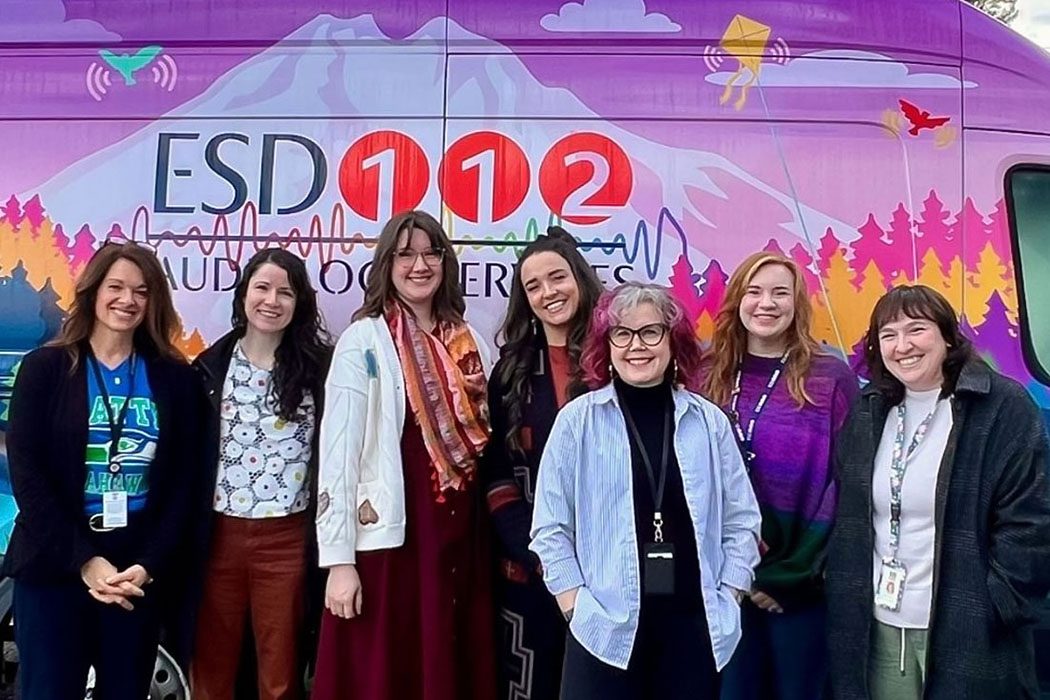
ESD 112’s Mobile Audiology Clinic has been selected as one of only 14 programs nationwide to participate in the 2026 Mobile Health Impact Accelerator (MHIA) through Harvard Medical School, making it the first mobile audiology clinic in the country to join this distinguished initiative.
The selection marks a significant milestone not only for ESD 112, but for mobile audiology programs nationwide. Through this partnership, the clinic will contribute to and benefit from Harvard’s Mobile Health Map, a collaborative research initiative and digital hub designed to track, analyze and elevate the impact of mobile health clinics serving communities across the country.
Dr. Kalani Cox, an audiologist at ESD 112 and the lead on the partnership, said the opportunity signifies both recognition and responsibility.
“Being selected by Harvard Medical School affirms the impact and importance of audiology services across a lifespan, from helping shape the trajectory of a young child’s journey to promoting connection and cognitive health in older adults,” Cox said.
“Pediatric and Educational Audiologists are uniquely trained to look at the whole child, considering how hearing and language access impacts every facet of their development. Mobile and teleaudiology services help bring quality care directly to children and families who might otherwise face barriers to access.”
ESD 112’s participation is part of a broader collaboration with Harvard University aimed at measuring the real-world impact of audiology services. The initiative will evaluate both financial and social return on investment (ROI/SROI), as well as quality-of-life (QoL) outcomes and their effects on early intervention, language development, education, social-emotional learning, cognitive neuroscience, prevention, and public health.
Hearing loss ranks as the third most common health condition in the United States, affecting about 50 million Americans—roughly 1 in 7 people. It impacts 2 to 3 out of every 1,000 infants, and up to 20% of children experience some form of hearing difference by age 12. Language deprivation, an epidemic affecting up to 70% of Deaf, Hard of Hearing, and Deafblind children, is defined by the National Institutes of Health (NIH) as a lack of full access to language during the critical first five years of life.
It is not caused by deafness itself, but by insufficient, inconsistent linguistic input (spoken or signed) in a child’s environment, which leads to permanent neurological, cognitive, and social-emotional challenges.
“It’s also completely preventable,” says Cox, “prompting a growing number of medical and educational professionals to advocate for change.”
Audiologists play a crucial role in helping prevent language deprivation by ensuring children receive timely, consistent care and support from a comprehensive team of key specialists. They also help children access fully accessible language(s) with multiple opportunities for linguistic input during this critical development window. Without these supports, linguistic neglect can severely impact a child’s development, mental health, academic success, and employment prospects.
Audiologists are typically the first providers to identify hearing differences, often serving as a gateway to other services by connecting individuals and families with essential supports and resources. The partnership with Harvard Medical School aims to develop expanded screening tools for providers that adopt culturally responsive practices and terminology, and capture a more holistic snapshot of a child’s development across different domains and disciplines.
Cox said assessing impact goes beyond just numbers; it tells the story of how hearing health transforms lives.
“Through our work on transdisciplinary teams, we’re supporting language, literacy, inclusion, confidence, and long-term success,” Cox stated. “This collaboration allows us to demonstrate the measurable ripple effect of Audiology services on developmental, educational, and social-emotional outcomes that impact the long-term quality of life for Deaf, Hard of Hearing, Deafblind, and neurodiverse students with hearing differences.”
The six-month Mobile Health Impact Accelerator, funded by the Centers for Disease Control and Prevention, is offered at no cost to selected participants. The program provides mobile health clinic teams with practical tools to improve sustainability, strengthen community partnerships, and communicate impact effectively.
Through online classes and personalized one-on-one sessions, participants develop essential materials, including a professional one-pager, an impact case study, an asset map and a sustainability action plan. The Accelerator also highlights community engagement, requiring programs to build relationships with local stakeholders and meet with government decision-makers to strengthen support and collaboration.
By the end of the program, ESD 112’s Mobile Audiology Clinic will have strengthened its evaluation strategies and further positioned itself as an essential part of the local public health ecosystem.
As the first mobile Audiology clinic selected for the Accelerator, ESD 112 is helping to pave the way for similar programs nationwide, demonstrating that bringing audiology services directly into communities not only increases access but also transforms lives.
For ESD 112’s Specialized Student Services division, the recognition reflects a broader commitment to equity and access across the region.
“We believe everyone deserves hearing health care that isn’t limited by where they live or what resources they have,” said Colleen Wahto, Director of Health Services at ESD112. “Our mobile clinic, and our incredible Audiology team, bring essential services to rural areas. This collaboration helps demonstrate why that access matters, not just for our students, but for the health of the whole community.”
ESD 112 thanks its dedicated audiology team and the families and communities who trust the clinic with their care. Their partnership makes this work possible, and this national recognition meaningful.
 ESD 112 equalizes educational opportunities for learning communities through innovative partnerships, responsive leadership, and exceptional programs.